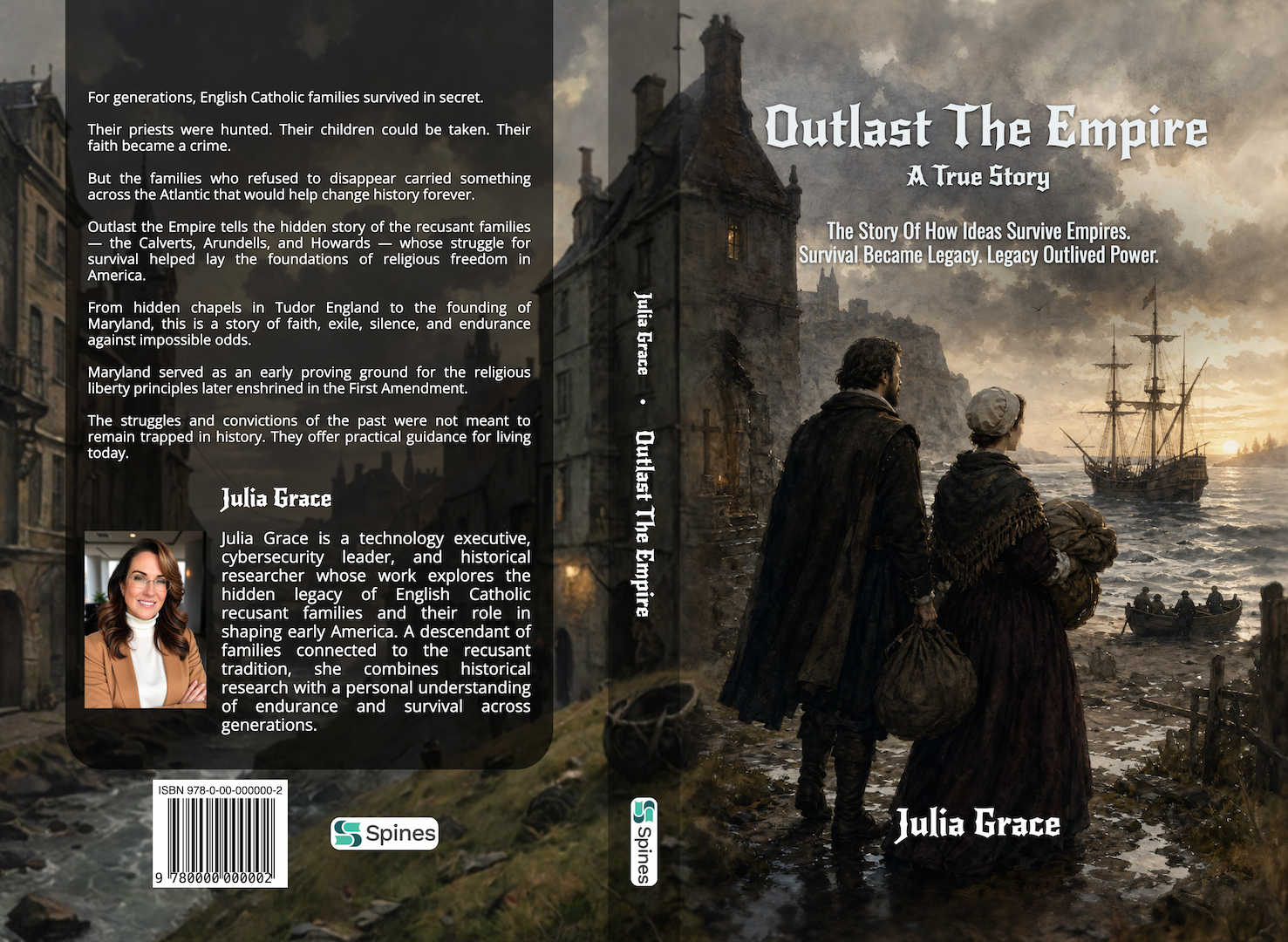
What does it mean to outlast an empire? For the men and women of the 16th and 17th centuries, it meant choosing faith over fear, family over power, and the unknown shores of a new world over the familiar chains of the old.
The Weight of a Choice
Every generation faces a moment when it must decide what it is willing to endure. For the recusant families of Tudor and Stuart England, that moment arrived not in a single dramatic confrontation but in a thousand small ones — a fine paid, a priest hidden, a child baptized in secret, a Sunday morning spent in a room that was not a church. The cumulative weight of those choices, made over decades and across generations, is what eventually carried them across an ocean.
Faith as an Act of Defiance
It is easy, from a distance of four centuries, to romanticize the recusant experience. The reality was grimmer. To practice Catholicism in Elizabethan England was to invite ruin. The fines for missing Church of England services were set deliberately high — twenty pounds a month, a sum that could strip a family of its land within a year. For the nobility, the stakes were even higher: the loss of titles, estates, and political standing. And yet families like the Calverts, the Arundells, and the Howards continued to practice. Not because they were reckless, but because they had decided that some things could not be surrendered.
The Long Road to Maryland
George Calvert, the first Lord Baltimore, spent years navigating the impossible geometry of loyalty to the Crown and loyalty to his faith. He served as Secretary of State under James I, rose to prominence, and then — in an act that cost him everything — publicly declared his Catholicism in 1625. He lost his office. He lost his seat on the Privy Council. What he did not lose was his vision: a colony in the New World where men and women of any Christian faith could live without fear of the state. He died before that vision was realized. His son Cecil carried it forward.
"Possibility does not arrive fully formed. It is built, slowly and at great cost, by people who refused to accept that the world as it was had to be the world as it would always be."
The Maryland Experiment
When the Ark and the Dove arrived in the Chesapeake in 1634, they carried something unprecedented: a charter that did not establish a state religion. The Maryland Toleration Act of 1649 went further still, making it illegal to persecute any Christian on account of their faith. This was not idealism. It was the hard-won pragmatism of people who had lived under religious persecution and understood, from the inside, what it destroyed. The colony they built was imperfect — it would later rescind its own tolerance under Protestant pressure — but the principle it established would not disappear.
What Possibility Looks Like
The story of the recusant families is not a story of triumph in any simple sense. Many of them suffered. Many lost everything. The colony they helped found was eventually taken from them. But the ideas they carried — that conscience cannot be legislated, that faith is a private matter between a person and their God, that a government which persecutes its people for their beliefs has exceeded its authority — those ideas survived. They found their way into the First Amendment. They became the foundation of the most durable experiment in religious liberty the world has ever seen. That is what possibility looks like when it is built by people who refused to give up.
A Note from the Author
This article is drawn from research for Outlast The Empire, available now. Julia Grace is a technology executive and historical researcher whose work explores the hidden legacy of English Catholic recusant families and their role in shaping early America.